What is Needle felting?
Updated: Aug 24
Needle felting is a process that involves matting, condensing and interlocking wool fibers together, using a special barbed needle. Typically sheep's wool is used for needle felting projects but various fibers can be used like, mohair, angora and alpaca.
What do you need to start felting?
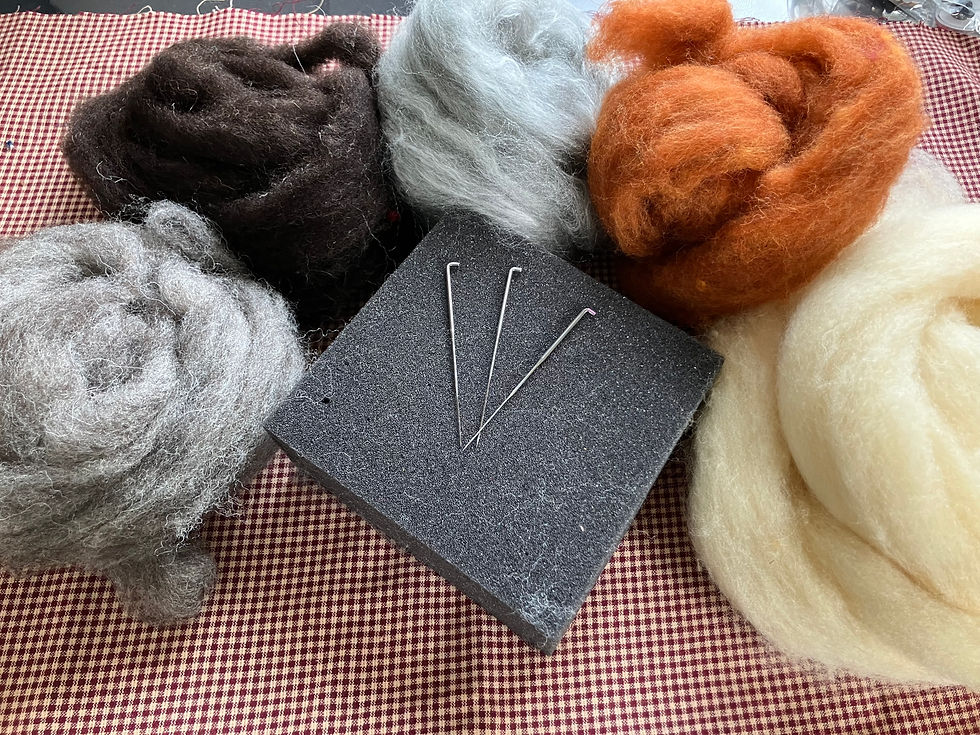
Needles, wool, and a felting mat!
Choosing Materials
choosing quality materials is important for your success in creating your felted creation.
You don't need much to get started.
Felting needles of various gauges
Wool suitable for felting
Felting mat
You'll want a few different gauge needles to get started with. There are a ton out there but I recommend keeping it simple when you're just starting out. I like to start with a 36G triangle needle to get the main bulk of the felting done, especially for 3D sculptures. this needle is a bit larger and sturdier and makes quick work of the core wool. As you progress through your project and start working on the details youll want a finer needle. Perhaps a 38G or 40G for very fine details, Like creating little noses and mouths on your sculptures.
Not all wools are created equal, each breed of sheep has unique properties to their wool. They all have their place and different applications, but not all of them are best suited for needle felting.
To start you'll want a core wool, which is typically a less expensive, undyed wool for your base. This will be covered over with your dyed wool later. For a core wool I've had great success with Corriedale, Romney, Cheviot, Icelandic, Shetland, and Finnsheep. These can be great either carded in batts or as roving. For your dyed wool some really popular choices are Merino, and Corriedale. Personally, I'm not a huge fan of Merino in my projects, it can be very fine and I’ll notice little poke holes still visible in my finished project. So i prefer a little coarser wool for my projects. Ive dyed both Cheviot and our Finnsheep wool and had good success. I haven't used every breed of wool so there could be better options out there, but these have worked for me. It can be really fun to experiment with new wools and see how their properties translate into your work. I highly recommend "The Fleece and Fiber Sourcebook" by Carol Ekarius and Deborah Robson If you're really interested in the different properties of wool by breed.
Felting pads can be as simple as a sponge, or you can get high density foam or even a wool pad. the purpose of a felting pad is so you're not poking your needle into the table or whatever your work surface might be. Sometimes I felt in my lap so a felting pad is important!

The Most Important Thing
The most important thing is to have fun, felting is very forgiving and the possibilities of things you can create is practically limitless. Start simple and work your way up to more challenging projects. You might be surprised with what you can create even if you don't consider yourself creative.
Comments